Saturday, October 22, 2022


CIVIL SOCIETY ORGANISATIONS PLAY A VITAL ROLE IN NATIONAL DEVELOPMENT

LOSCO a vibrant and Human Rights Focused NGO based in Kigezi Sub region of Uganda on the Western part is a one stop Centre for Human Rights Advocacy and does work around HRDs, Land Rights, Climate Justice, Social Justice, Governance in Health, Transparency and Accountability with the final beneficiary in mind. Its started this work in 2019 and the effects of COVID-19 came through so hard on programs and implementation plans but still managed to sail through.

Now LOSCO stands as the Most Vibrant CSO in Kigezi Sub region coordinating all HRDs in the region with focus on Human Rights Education and Capacity Building to the Human Rights CSOs and Government Agencies.

In a country blessed with peace and stability, civil society fills the space untouched by government and the private sector. In a fragile and conflict-ridden country, it plays an even more important role of providing services normally the responsibility of the state and business and can lay the foundation for reconciliation.


 ‘If anyone needs a crash course in the critical role played by civil society organizations, COVID-19 is providing it—from increased need for the services they provide to those less fortunate, to the strain they are experiencing from lack of supplies and the need to “social distance,” to government having to act too quickly without civil society input. Nevertheless, beyond the current crisis, civil society is an essential building block of development and national cohesion.

Civil society organisations (CSOs) are a large and strategic sector of working across a wide range of thematic areas including the promotion of accountability and transparency, citizens’ participation, democracy, human rights, gender, youth, jobs and livelihoods, health, education, agriculture, migration and forced displacement, water and sanitation, and environmental protection among others. In addition, the CSOs in Uganda belong to a range of groups and organisations including trade unions, professional associations, faith-based organisations (FBOs) and cooperatives. The NGOs as a sub-group of CSOs have been more visible and more or less become synonymous with the term CSOs due to the nature of their work in Uganda.


Civil Society Organizations (CSOs) are recognized globally for their enormous contributions towards addressing economic, social, and political challenges including raising human right violations within communities. CSOs have evolved overtime and assumed different forms including organized and organic groups of different sizes and functions such as community-based organizations, workers’ or labour unions, professional associations, and nongovernmental organizations (NGOs).3 In some jurisdictions, the role of CSOs is embedded in legal and policy frameworks.

While civil society in Uganda has been influential in contributing to the socio-economic and political development of the country as documented in multiple studies, the sector is plagued by several restrictions, which include inter alia: the shrinking civic space for their operations caused by negative narratives, which are tattled around. the multiplicity of administrative and legislative requirements for compliance. This is all on the backdrop of decreasing funding.


In Uganda, the Constitution grants CSOs mandate to protect and promote Human Rights of Ugandans. However, many governments especially those in the Global South have limited the civic space for CSOs, especially democracy and human rights organizations. Additionally, CSOs also continue to struggle with dwindling donor funding and shifting priorities driven by foreign policy considerations that pose a threat to their sustainability. In realizing sustainability amidst the changing trends, it is increasingly important for CSOs to prioritize developing diversified sources of institutional and financial support; and strengthening governance and leadership capacities.


With increased reports of corruption; maladministration in the public sector, increasing poverty levels, apathy among citizens, increase in criminality, human rights violations, poor service delivery, poor environmental governance and the resulting degradation of the environment; limited action on accountability concerns; the CSOs still have some work to do.


Friday, September 16, 2022


HUMAN RIGHTS EDUCATION – ROLE OF THE YOUTH IN PROTECTING AND PROMOTING HUMAN RIGHTS

WHO IS A YOUTH?

The time of life when one is young especially :  the period between childhood and maturity. The early period of existence, growth, or development

A young person especially : a young Male/ Female between adolescence and maturity

Uganda's National Youth Policy defines youth as those aged between 18 and 30. In contrast, the East African Community (EAC) defines youth as those between 15 and 35 years while the United Nation's definition is 15-24 years.

Youth have the creativity, the potential and the capacity to make change happen – for themselves, for their communities, and for the rest of the world. LOSCO works with young people and is committed to accompany them to work together to drive social innovation and change, participate fully in the development of their societies, eradicate poverty and inequality, and foster a culture of peace and Human Rights.

Participation in the protection & promotion activities can help youths become better informed about current events.

Human Rights go Hand in Hand with Human Responsibilities but ignorance of one affects the role of the other.

It stresses that developing capacities for participation is an important result in itself.

The youth can preserve human rights for generations and implant the importance and value of human rights in people's hearts.

Youth is the link between children and adults. The message of human rights will be conveyed to these two groups by the youth.

As youth, we should convey the message of human rights to society.


Young people face discrimination and obstacles to the enjoyment of their rights by virtue of their age, limiting their potential.

The human rights of youth therefore refers to the full enjoyment of fundamental rights and freedoms by young people.

Promoting these rights entails addressing the specific challenges and barriers faced.

WHAT CHALLENGES AND DISCRIMINATION DO YOUNG PEOPLE FACE?

Pursuant to Human Rights Council Resolution 35/14, The documented discrimination and some of the challenges for young people in accessing civil, political, social, economic and cultural rights are here with Highlighted.

Participation: Youth are under-represented in political institutions, with less than 2% of parliamentarians worldwide aged under 30. Moreover, the age of candidacy for national parliaments, and especially for higher office, is not always aligned with the minimum voting age.

School to work transition: Young people worldwide are three times more likely than adults to be unemployed.

Access to health, including Sexual and Reproductive Health and Rights: In some countries, parental notification is required for young people to access sexual and reproductive health services, such as menstrual goods and services.

Youth in vulnerable situations: Young migrants including asylum seekers and refugees, young people in conflict with the law and youth with disabilities face additional challenges due to their specific situation.

Age is one characteristic that often intersects with, adds to and multiplies discrimination based on other grounds, thus preventing many young people from enjoying equal opportunities and substantive equality.

"As people face more and more Human Rights challenges, in terms of economic, social & environmental factors as well as mental health issues, the potential for simple programmes like community empowerment to improve resilience is really necessary.”

Our communities are stronger when everyone has the opportunity to contribute. Your involvement as Youths can help a community establish relationships through coordination, gain knowledge, and be better prepared to face dynamic Human Rights challenges.              


WHAT THEN CAN THE YOUTHS DO TO PROTECT AND PROMOTE HUMAN RIGHTS

In its resolution 1983/46, adopted at its 39th session, the Commission called upon states to take appropriate action for the exercise by youth of all their human rights, including the right to education and the right to work, "with a view to creating conditions for the active participation of young people in the formulation and implementation of programmes or the economic and social development of their countries”. “the need to educate young people in the ideals of peace and mutual understanding, respect for human rights and fundamental freedoms and dedication to the aims of social progress and development.

ARTICLE 38 CIVIC RIGHTS AND ACTIVITIES

(1) Every Uganda citizen has the right to participate in the affairs of government, individually or through his or her representatives in accordance with law.

Article 53 Mandates UHRC

CHAPTER 4 – HUMAN RIGHTS AND LIBERTIES

First, the right of youth to appropriate education, training and work. The education youth should receive must not only involve training in the skills necessary for gainful employment through the practice of a trade or profession, but also provide moral and spiritual enlightenment. youth will be able to offer their fullest contribution to society only when they receive proper moral and spiritual education.

Secondly, should be able to participate actively in implementing projects dedicated to improving living conditions, upraising the quality of human life, and developing the self-reliance of their communities. youth could be encouraged to promote the spread of literacy; to participate in projects aimed at improving health care and medical treatment; to contribute to community service programmes of a humanitarian nature.

Thirdly; Youth need to contribute to the enjoyment of human rights and the establishment of world peace, At the same time, to achieve this full enjoyment of human rights youth must also be at the forefront of efforts to promote social and economic progress and justice. 

Fourthly; Speak up for what you care about. We all have something that we care deeply about, whether because of an experience we underwent, an encounter we've witnessed, or a story spoken by someone close to us. Advocacy has a huge impact in communities everywhere.

One brave voice is enough to open up a channel for others to share their experiences and support human rights.

LASTLY; Stand up against discrimination.

Discrimination has a way of creeping up in places we never imagined encountering it. When we have each other as support, we are more empowered against injustices in the workplace or in a classroom.

Acting together, we're powerful enough to pave a new path to equality and fairness.


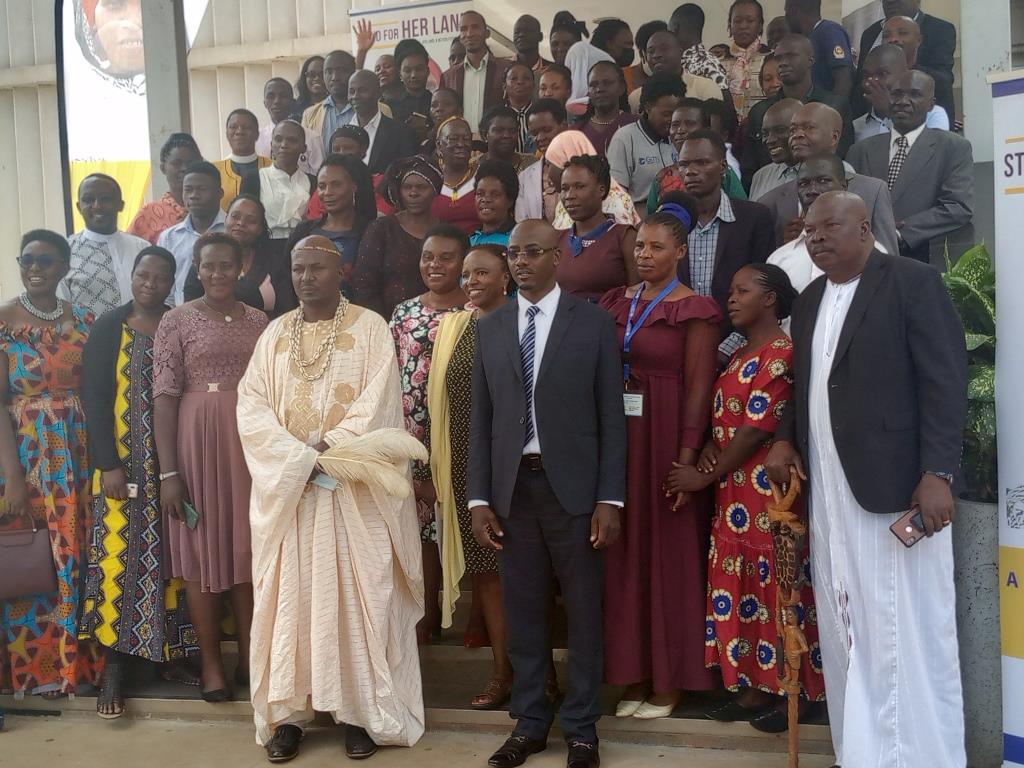
THE STAND FOR HER LAND CAMPAIGN LAUNCH IN UGANDA

Stand 4 Her land Campaign has an enormous ambition of making land rights a reality for millions of women around the world, including our beloved country Uganda and it works through collective country led advocacy aimed at closing the implementation gaps between normative aspirations reflected in Uganda’s laws and the lived realities and practice in regards to women’s land rights.


It’s well understood the nature of Tenure in Uganda, this can be dealt with through removing the social, and structural barriers that prevent women from exercising their land rights and ensuring that land tenure governance, reforms and processed equitably include and benefit women.


LOSCO in Partnership with UCOBAC and NLC-U envisages the five key campaign strategic advocacy priority areas to actualize the women’s land rights. They include transformation of social norms and cultural practices that prevent women from accessing, owning and controlling land; adequate financing, skilling and capacitating of land governance institutions to support WRL; increased legal literacy on WLRs for all, enhanced access to land justice for women; and strengthened participation, voice and agency of grassroots women in land governance.


The need to move from Talk to Action especially the need to understand Land in relation to Climate Change considering the linkage through Recognizing the role that Land plays in Climate - Providing and holding resources. Western economies pay to keep the natural resources. Who are the best people to keep? the owners. Avail Alternatives. Maintain the Carbon sinks intact i.e Swamps and Forests.


Address peer pressure for men taking equal stand as women. Empower men too because Titling cannot solve women's land issues.


JUSTIFICATION FOR WOMEN'S LAND RIGHTS

Has it matured or retrogressed? Human Rights Argument trying to enlight that women have the right to own and possess property too.

Equity, women over 50% of the population and more than 70% in Agriculture.

Thus, Women would have more rights to own the Land. Enable the Woman to Clearly and resourcefully empower the owners of this Land.

Consider Succession Act, CEDAW, ICSER


Administrative Regulations and need to fill the big gap that exists in implementation of the Law...

Land Rights Laws for women have existing controversies for instance Marriage is upon Canon Law and divorce is done via Statutory Law....

The issue of Duty bearers in public offices that facilitate corruption through bureaucratic tendencies


RECOMMENDATIONS

- Land Rights are personal with societal implications. They are interpersonal. Get to private spaces for influence to Materialize.

- Appeal to the man to appreciate the need for inclusion of women in the titles.

- Do stakeholder analysis for collaborative traction and involve program style interventions than Project ones. Consider prevalence than severity

- Interventions need maturity periods. The political will has a telling impact. Work on women as a Constituency.

- The campaign can target CP LCIII and V to nominate strategic women on the Committees. Target the duty bearers. That is Practice Activism.

 There is no Blue print on how National policy is incorporated into Land Rights


.


Monday, July 18, 2022

 RADIO TALK SHOW ABOUT UGANDAN INCOME STATUS

UBOS VISA VIS WORLD BANK RATING

The president of Uganda H.E Yoweri Kaguta Museveni after the Budget Speech showed the will to get to the Middle Income Status but the means have to be analysed further. Political will and commitment but “You don't award yourself marks in an assessment or Exam, you will be disappointed” simply because what you wish is not what you have at the time.

The method of assessment was presented in the first World Development Report (World Bank, 1978), and its origins can be traced even further back. In 1965, for instance, a published essay “The Future of the World Bank” used gross national product (GNP) per capita to classify countries as very poor(low income), poor(lower middle income), middle income(upper middle income), and rich( high income) (Reid,1965) used since 1989. It divides countries into four groups and —using gross national income (GNI) per capita valued annually in US dollars using a three-year average exchange rate (World Bank, 1989) adjusted each year in line with price inflation. The classification is revised once a year on July 1, at the start of the World Bank fiscal year.

The World Bank uses the income classification in World Development Indicators (WDI) and other presentations of data; the main purpose is analysis.

World Bank is a Monitor for World development and continues to do the same work every year based on GNI per Capita in the selected countries.

The world's Middle Income Countries (MICs) are a diverse group by size, population, and income level. They are lower middle-income economies - those with a GNI per capita between $1,036 or UGX 3,833,200 and $4,045 or UGX 14,966,500; and upper middle-income economies - those with a GNI per capita between $4,046 UGX  14,966,500 and $12,535 or UGX 46,379,500 (2021). Middle income countries are home to 75% of the world’s population and 62% of the world’s poor. At the same time, MICs represent about one third of global GDP and are major engines of global growth.

Uganda's Total exports increased by 11.5 percent in February 2021 to US$ 413.6 million from US$ 370.8 million recorded in January 2021. Total imports flows increased by 21.3%

Uganda tax base 21.6 TN for the year ended June 2022 short of the 22.5TN Target from Domestic Taxes which is meant to finance Uganda’s budget of UGX 44tn for the Financial Year 2022/2023.

Debt standing at 52% of GDP, which puts the majority of the citizen’s financial status in limbo.

While lower MICs struggle with the provision of basic necessities, such as clean water and food, look at Karamoja.... 44 people dead because of hunger and yet Uganda is a home for food but planning is still a challenge where Human Rights Based Approach needs to be considered in allocation and distribution of resources.

A nation or state is as Good as her Population and as it stands The state of Health is still below the level of middle Income - Medicine so lacking, Mothers still dying while giving birth, Children dying of malnutrition, Social Services are still lacking in quality because of Capitalism than Socialism.

Education Standards determine the state of a nation. Nelson Mandela once said “Education is the great engine of personal development. It is through education that the daughter of a peasant can become a doctor, that the son of a mineworker can become the head of the mine; that a child of farm workers can become the president of a great nation” and “No country can really develop unless its citizens are educated”

Uganda still have issues with the Education policies; labs with no apparatus, schools with no structures, libraries with old books, limited access to internet in schools not mentioning the SRHR information and Sexuality Education.

Leaders need to look at production than consumption / dependence economy through practical experience. Where is the market? Agricultural products have no value, when is the value chain going to be improved? How are Industries and Factories regionally distributed?

Unemployment Rate in Uganda is expected to reach 3.10% by the end of 2022, while Kenya is already 2.5%, TZ 2.6%.

Upper MICs tend to face larger governance-related problems, such as rampant corruption, Monetization of elections/dictatorship

Recommendations

 ·         Industrial Development should be priority for income and social development considering the  Regional Hubs for industrialization.

 ·         Income gap among the citizenry should be translated into people's pockets. Improve the social services to the population and reduce expenditures on Health from out of pocket to Health Insurance

 ·         Inflationary tendencies - pricing and price controls and subsidies on the social services. The Government and Ministry of Finance can control this.

 ·         Human Rights based Approach should be key in the planning process. Do grassroots research for better management and ownership to ensure no one is left behind as opposed to the expert model where desk research is just done to complete the task with no grass root involvement and participation.

 ·         Increase the commitment to fight corruption in all MDAs and Systems and institute heavy punitive measures because corruption kills citizens.

Wednesday, July 13, 2022

ACCESS TO SRHR INFORMATION AND SERVICES IN KIGEZI SUB REGION


ACCESS TO SRHR INFORMATION AND SERVICES IN KIGEZI SUB REGION

BACKGROUND

There is still a challenge with accessibility of SRHR information and Services at most of the Centres and Units all around Kigezi Sub Region

LOSCO in Partnership with CEHURD /COPASAH came in with an effort where a Hybrid Dialogue was conducted involving the Duty Bearers, Community Leaders and Health Service Providers to address the issue in a comprehensive manner. A consensus was reached appreciating that these services are still insufficient in most of the health units and urgently needs to be addressed to prevent the risky Maternal Mortality rates in Kigezi Sub region.


This was seen to have been partly responsible for the rise up of Teenage Pregnancies in Kigezi Sub Region because of the myths the youths and parents still believe in and limitation in movements for the services. This is also attributed to the mysterious deaths of youths and mothers due to un safe abortions.

A report was shared and the next steps suggested to the lead implementers of health Programs, there was a Media engagement to further spread the information and all this was coupled with a Radio Talk Show with the Local Leaders and the DHO that took up the responsibility to have this addressed with colleagues in the sector. Apparently Kabale District Local Government is following it through the Human Rights Based Approach in all program Areas and SRHR is considered among others like social justice and climate change.

LESSONS

LOSCO observed that even the Leaders in the Health sector undermined the power of information and appreciated the intervention which should ultimately be cascaded out of the Health Centres to Communities that include schools and institutions of learning.

From the Implementation, LOSCO learnt and is from the subsequent engagements still learning that Participatory approach to the interventions is critical for the sustainability of the positive results if SRHR is to make meaning in not only youth livelihoods but also amongst the parents and communities

The best practice is using the Human rights based approach that will promote inclusivity where no one is left behind along the eco system of interventions and service delivery.

Other than the Traditional Norms and Values that Bakiga believe so much in, there is a challenge when it comes to consistence in our efforts to deconstruct the narrative that comprehensive sexuality education will be the best if not the only way out. LOSCO’s Capacity is still limited in the financial aspect of things. Every other issue is taken care of except that one.


LOSCO is however adopting the aspect of partnerships where different entities have been approached that include New Partners in Environmental Conservation to include SRHR information. Also LOSCO’s HRE Programming includes SRHR as a cross cutting issue when it comes to Addressing the Gender Inclusivity and Intersectionality approach. A coalition is soon to be established that will address Climate Change and SRHR is at the centre of Programming where RHU will be on board to support with Experience.


PROGRAM IMPLICATION

This will be scaled up through increasing Access to Sexual Reproductive Health & Rights (SRHR) services and information for all through community mobilisation in Kigezi Sub Region and also continuous awareness raising and promoting Health Service equity among the populations through social mobilization and accountability by citizens with good governance in health that are rights based. Otherwise it remains at a local level.

For this Scale up to materialize, there is need to consider taking the HRB SRHR Information Sharing to Schools and Institutions, Consistent radio talk shows targeting the working class and parents in their homes, engaging the duty bearers on a regular basis building their capacity and zeal to influence policy formulation on the same.

For the implementation to impact SRHR programming broadly, there must be intentional messaging targeting specific audiences and this be done on a regular basis because for mindset change, consistence is key.

RECOMMENDATIONS

To partners;

There has to be continuous Advocacy with Evidence and relationship building with stakeholders through continuous engagements

Ensure Compliance with the Law so the Advocacy efforts are not watered down through noncompliance crackdown

Need to work closely with the Communities especially the leaders and create partnership with governments in their regions

To the coalition:

Has to intentionally scale up if resources allow to cover a wider area (all regions)

Design uniform Messages to target different Audiences and all languages and disseminate  through members

Train some media Houses and Journalists on the best way to bring the message home and intentionally select the Media Houses and Channels to use for a broader reach depending on the regions.

Offer support and referral information access points for more information


MoH;

Institute health corners for the young and key populations at all health units

Build capacity for VHTs to play a more supportive role than the usual routine work.

Train the Government Health Providers in providing specialised care and information services

Funders;

Support the initiatives partners are implementing like Medical Outreaches (Grassroots Approach), Information sharing materials and efforts


LOSCO QUARTERLY HUMAN RIGHTS SITUATION ANALYSIS AND KEY ISSUES IN KIGEZI

  April 1, 2025   Dear Human Rights Defenders, Actors and Partners in the Promotion and Protection of Human rights; A Happy New Month!...